D.R. Horton Robot-Built Homes (November 2026): Cost, Safety, Drywall, Build Time and North Texas
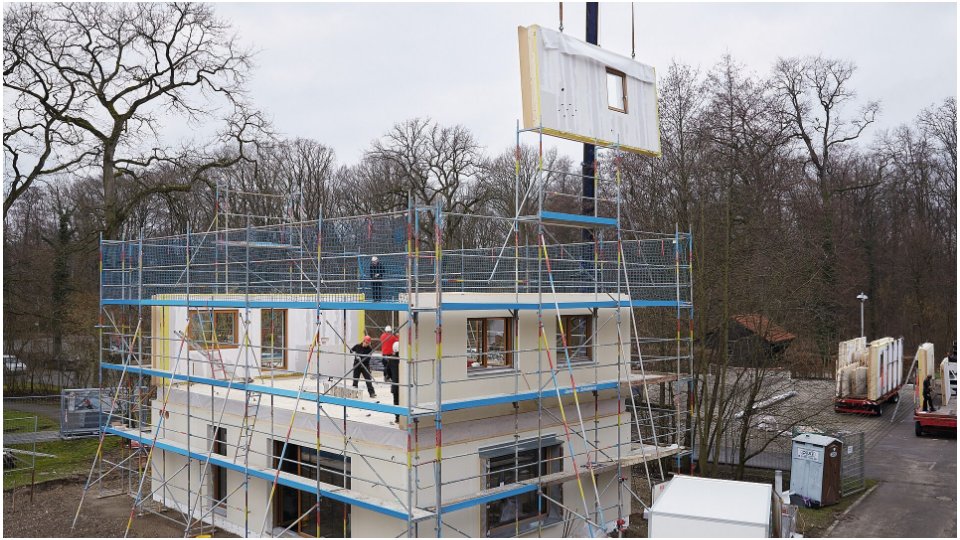
Factory-built wall panels being craned into place on a prefab home in Rheinau-Linx, Germany (February 2019). Shown to illustrate panelized construction. This is not a D.R. Horton or Promise Robotics home. Photo: Simone Böttcher-Murr, Murr PhotoArt via Wikimedia Commons, CC BY-SA 4.0, cropped.
If you have seen the headlines this fall, you may have read that D.R. Horton is "using robots to build homes." That is partly true, and the details matter a lot if you are shopping for a new build in Dallas-Fort Worth. D.R. Horton robot-built homes are real, but they are not coming off a robot assembly line in Arlington, and the robots are not walking around a job site in Celina or Forney. On October 13, 2026, D.R. Horton signed a multi-year deal with Promise Robotics, a Toronto-based company whose robots build wall, floor and stair framing inside a factory. The first homes are planned for metro Phoenix, and the factory is not expected to start production until early 2027.
This November 2026 guide explains what the robots actually do, what these homes are likely to cost, whether D.R. Horton builds with this system in North Texas, how safe and code-compliant robot-framed homes are, whether they still use drywall, and what it could mean for price and build time. We finish with pros and cons for buyers and a new-construction checklist you can use on any D.R. Horton home in DFW today.
Key Takeaways
- What it is: D.R. Horton signed a multi-year agreement with Promise Robotics to use its "Factory-as-a-Service" robotic production for more than 1,250 homes (Promise Robotics press release, Oct. 13, 2026).
- What the robots build: framing components such as wall panels, floors and stairs, made in a factory and trucked to the site, where trained crews set them in place. It is panelized framing, not 3D printing and not a full modular home.
- Where: all 1,250-plus homes are planned for metro Phoenix, from a roughly 16,000-square-foot plant in the Gilbert area expected to open in early 2027 (ResiClub, Oct. 21, 2026; KRLD/Audacy, Oct. 28, 2026).
- North Texas: D.R. Horton is headquartered in Arlington and builds across DFW, but no North Texas factory or community has been announced for robotic framing as of November 2026.
- Drywall: yes, these homes still get drywall. The robots handle the structural frame. Drywall, plumbing, electrical, HVAC and finishes still follow on site.
- Build time: Promise says it can make the framing for a typical 1,800-square-foot, two-story house in about eight hours in the factory. Those are company claims for the frame only, not the whole home (HousingWire, Oct. 13, 2026).
- Price: no per-home savings have been disclosed. Framing is roughly one-tenth of a typical new home's sales price in national builder survey data, so even big framing savings would move the price modestly.
What D.R. Horton Actually Announced (October 2026)
D.R. Horton, America's largest homebuilder by volume for 25 straight years, announced a multi-year commercial agreement with Promise Robotics on October 13, 2026. D.R. Horton became the first major U.S. homebuilder to use Promise's production platform as the startup expands into the United States.
Brad Conlon, D.R. Horton's senior vice president of strategic growth and innovation, said in the announcement: "We are continuously focused on improving cycle times, increasing production capacity, and bringing greater consistency and predictability to our operations. Promise Robotics' integrated platform gives us a new capability to support those goals."
On D.R. Horton's fiscal fourth-quarter 2026 earnings call (October 2026), CEO Paul Romanowski described it this way when an analyst asked about the deal: "That's a pilot program for us in the Phoenix market, looking at some kind of a panelization process. We're going to watch it really closely" (Investing.com earnings call transcript, Oct. 2026).
That word "pilot" is important. ResiClub noted that D.R. Horton closed 84,863 homes in fiscal 2025, so roughly 1,250 homes is about 1.5% of one year's volume. In metro Phoenix, though, 1,250 homes is more than half a year of D.R. Horton's recent closings across Maricopa, Pinal and Pima counties, so it is a meaningful local test.
The deal at a glance
| Detail | What has been reported | Source and date |
|---|---|---|
| Partner | Promise Robotics (Toronto-based; factories in Edmonton and Calgary) | Promise press release, Oct. 13, 2026 |
| Homes covered | More than 1,250 | Promise press release, Oct. 13, 2026 |
| Location | Metro Phoenix, Arizona | ResiClub, Oct. 21, 2026 |
| Factory | About 16,000 sq ft, Gilbert area, production expected early 2027 | BetaKit and KRLD/Audacy, Oct. 2026 |
| Home type | Largely single-story, single-family homes | BetaKit, Oct. 2026; KRLD/Audacy, Oct. 28, 2026 |
| What robots make | Framing components such as walls, floors and stairs | HousingWire, Oct. 13, 2026 |
| Who owns the robots | Promise Robotics owns the factory, robots and software; D.R. Horton buys output | ResiClub, Oct. 21, 2026 |
| Financial terms | Not disclosed | ResiClub; HousingWire, Oct. 2026 |
| North Texas | No DFW factory or community announced | All announcements reviewed, Nov. 2026 |
How the Robots Build a House (Step by Step)
People picture a robot pouring a whole house. That is not this. Promise Robotics uses off-the-shelf industrial robot arms (The Robot Report says KUKA arms) fitted with Promise's own tools and AI software. Here is the workflow, as described by ResiClub and HousingWire:
- Design translation. Promise's AI reads D.R. Horton's existing floor plans. The builder does not have to redesign its homes for the factory.
- Production planning. The software turns those plans into manufacturing instructions, down to studs, sheathing and fasteners.
- Robotic manufacturing. In the factory, pairs of robots cut, place studs, frame window openings and nail or staple sheathing to build wall panels, floor sections and stair assemblies. Offsite Builder Magazine reported that two robots can perform more than 240 separate tasks on a simple wall.
- Delivery. Finished panels are trucked to the job site in the order they will be installed.
- Site installation. Trained crews set the panels on the foundation and connect them, much like the crane photo above. After that, the home is finished the traditional way.
Promise says its software sets fastening patterns to match local building codes. CEO Ramtin Attar told The Robot Report that Phoenix homes required "50% less sheeting and different bracing" than homes in Canada's harsher climate, which shows the system adapts to local engineering rather than using one design everywhere (The Robot Report, Oct. 13, 2026).
Does D.R. Horton Build Robot-Framed Homes in North Texas?
Not as of November 2026. Every report we reviewed places the Promise Robotics homes in metro Phoenix. Promise told ResiClub that all 1,250 homes will be built and located there. No factory, no community and no timeline has been announced for Dallas-Fort Worth.
Here is what is true about D.R. Horton and North Texas:
- Headquarters: D.R. Horton is based in Arlington, Texas, which is why local outlets like KRLD covered the deal.
- Divisions: D.R. Horton lists separate Dallas and Fort Worth market areas on its website and sells across the metro, from Princeton and Sherman to south Dallas, Lancaster and Fort Worth.
- Regional volume: D.R. Horton's South Central region, which includes Texas, closed 22,045 homes in fiscal 2026, more than any other region in the company (D.R. Horton fiscal 2026 results, SEC filing).
- Other offsite methods: D.R. Horton already uses factory-made parts in many places. A D.R. Horton architect told Offsite Builder Magazine (March 2025) that the company works with suppliers nationwide for roof and floor trusses, I-joists, wall panels and panelized systems, and said, "We're not looking to replace anything, just add to it." That is national commentary, not a DFW-specific program.
Could it come to DFW later? It is possible. Promise says it plans to keep adding U.S. factories and builders, and D.R. Horton's divisions decide locally how they build. But treat any claim that robots are framing D.R. Horton homes in DFW today as unverified. If a sales rep says a specific home was robot-framed, ask for it in writing.
How Much Would a Robot-Framed D.R. Horton Home Cost?
No one has published a price for a Promise-framed D.R. Horton home. The companies did not disclose financial terms, and the Phoenix plant has not started production. So here is a reasoned, clearly labeled estimate built from D.R. Horton's own reported numbers.
| Price benchmark | Amount | Basis |
|---|---|---|
| D.R. Horton average closing price, Q4 FY2026 (July to Sept. 2026) | $365,600 | Earnings call, Oct. 2026 |
| D.R. Horton average price of new orders, Q4 FY2026 | $356,600 | Earnings call, Oct. 2026 |
| Southwest region (Arizona plus higher-cost states such as California) average closing price, FY2026 | About $478,000 | Our math: $4,312.0M on 9,013 homes, SEC filing |
| Entry D.R. Horton Express plan in metro Phoenix (Elena Trails, Maricopa, AZ) | From $321,990 | D.R. Horton website, Nov. 2026 |
| South Central region (includes Texas) average closing price, FY2026 | About $297,000 | Our math: $6,551.9M on 22,045 homes, SEC filing |
| Entry D.R. Horton plan in Fort Worth (Orchard Village, Acorn) | From $249,990 | D.R. Horton website, Nov. 2026 |
Our estimate (not a quote): a robot-framed D.R. Horton home in the Phoenix pilot would most likely be priced like the D.R. Horton homes around it, roughly from the low $300,000s for entry single-story plans up to the mid-$400,000s. That range runs from D.R. Horton's current Phoenix-area Express pricing to the Southwest region's fiscal 2026 average, which California and other higher-cost markets pull upward. If the same system ever came to DFW, we would expect it to sit in D.R. Horton's existing local price bands, roughly the $250,000s to $400,000s for most communities, rather than create a new premium or discount tier. Builders price homes to the local market, not to the cost of one construction step.
Does Robotic Framing Lower the Price?
This is the question everyone asks, and the honest answer is: maybe a little, eventually, and it has not been proven yet. HousingWire pointed out that neither the announcement nor its interview disclosed "independently verified per-home savings."
To put the possible savings in perspective, the National Association of Home Builders' 2024 cost survey found that construction costs average 64.4% of a new home's sales price, and the framing stage averages 16.6% of construction cost (NAHB Cost of Constructing a Home, Jan. 2025). Multiply those and framing works out to about 10.7% of the sales price. D.R. Horton's own cost mix may differ, so the table below is a hypothetical illustration, not a forecast.
| Home price | Framing share (about 10.7%) | If framing cost fell 10% | If framing cost fell 20% |
|---|---|---|---|
| $297,000 (South Central FY2026 average) | About $31,800 | About $3,200 | About $6,400 |
| $365,600 (company Q4 FY2026 average) | About $39,100 | About $3,900 | About $7,800 |
| $478,000 (Southwest FY2026 average) | About $51,100 | About $5,100 | About $10,200 |
Even in the best case, savings of a few thousand dollars are small next to the incentives D.R. Horton is already using. On the same earnings call, management said its rate buydowns run about 1.5 percentage points below market and that the high 80s to low 90s percent of its mortgage-company buyers use them. For a DFW buyer in November 2026, the incentive package and your interest rate will move your monthly payment far more than how the walls were framed.
Where robotics may matter more is consistency and supply. Faster, more predictable framing can mean fewer delays, less money tied up in unfinished homes and more homes delivered when labor is tight. D.R. Horton's management cited labor shortages tied to regulation and enforcement activity on the October 2026 call. Over time, that kind of efficiency can help a builder hold prices steady, even if it never shows up as a line-item discount.
Build Time: How Fast Are Robot-Framed Homes?
| Step | Reported time | Source and date |
|---|---|---|
| Factory production of framing for a typical 1,800 to 2,000 sq ft house with a basement | About 8 hours | Offsite Builder Magazine, Dec. 2025; HousingWire, Oct. 2026 |
| On-site assembly of those components | About 6 more hours | Offsite Builder Magazine, Dec. 2025 |
| More complex duplex projects | 2 to 2.5 days | HousingWire, Oct. 13, 2026 |
| Conventional framing of a comparable two-family home | Typically 2 to 3 weeks (Promise CEO's estimate) | The Robot Report, Oct. 13, 2026 |
| Typical D.R. Horton build in DFW today | About 5 to 7 months | OnDemand Realty D.R. Horton guide |
Remember that framing is only one phase. Plumbing, electrical and HVAC rough-ins, city inspections, insulation, drywall, cabinets, paint, flooring and final inspections all still happen after the frame is up. HousingWire noted that faster framing only creates value "if the builder can translate those gains into faster overall home completions." D.R. Horton said in October 2026 that its cycle times, measured from start to close, "remain near historical lows," and it did not give a target for how much the Phoenix pilot might shorten them.
Do Robot-Built Homes Still Use Drywall?
Yes. The robots build the structural skeleton: studs, plates, headers, sheathing, floor systems and stair assemblies. Inside, you still get gypsum drywall, taped, textured and painted like any other new home.
What changes, and what does not:
- Same basic materials: Promise focuses on wood panelization. Attar told Offsite Builder Magazine that "with panels, we can work with almost any builder who uses wood."
- Factory-applied layers: Promise's robots can apply sheathing in the factory, and the company says they are capable of gypsum installation on panels. The D.R. Horton announcement did not say which layers will be applied at the Phoenix plant.
- Open panels for inspection: Local rules can limit how much is closed up in the factory. HousingWire reported that some cities allow factory installation of windows, plumbing or mechanical systems while others restrict it.
- No change to finishes: cabinets, flooring, roofing, brick or siding and fixtures are still installed on site.
How Safe Are Robot-Framed Homes?
Structural safety and building codes
A panelized home must meet the same building code requirements as a stick-built home. Penn State's Pennsylvania Housing Research Center explains that panels are either "open," meaning every part can still be inspected at the job site, or "closed," which requires in-factory inspection and quality programs approved by the local building authority (PHRC, The Essence of Panelized Construction). HUD's model guidelines for engineered panelized walls say the same thing: the builder is responsible for meeting the governing code (HUD User).
In Texas, the law draws a clear line. The Texas Occupations Code says "industrialized housing" (state-regulated modular homes) does not include housing built with a sectional or panelized system that does not use a modular component (Texas Occupations Code Ch. 1202). In plain English, if open-panel framing like Promise's ever came to DFW, those homes would generally go through the same city permits and inspections as any other site-built home.
Safety for the people building it
Moving framing into a factory takes some work off ladders, roofs and open floor edges and out of Texas heat and storms. That is meaningful because OSHA calls falls "among the most common causes of serious work related injuries and deaths" (OSHA Fall Protection). We did not find published injury data for Promise's factories, so we are not making a specific safety claim beyond that.
What we would still watch
- Panel handling: wall panels are big (Promise says walls up to 20 feet and floors up to 45 feet). Careful crane work and bracing on site matter.
- Connections: the factory-made pieces are only as good as how crews tie them to the foundation and to each other. Strap, anchor bolt and hold-down inspections still apply.
- Track record: Promise says it has completed more than 200 builds in Canada. The U.S. program has not built a home yet.
Pros and Cons for Homebuyers
| Pros | Cons |
|---|---|
| Framing built indoors, out of rain and heat, with repeatable precision | Not available in DFW; Phoenix pilot starts early 2027 |
| Factory framing in hours instead of weeks, per company claims | No independently verified savings or cycle-time data yet |
| Could make delivery dates more predictable when labor is tight | Framing is only about one-tenth of the sales price, so price impact is likely small |
| Fastening set to local codes by software, with open panels inspectable on site | Quality still depends on site crews, inspections and follow-on trades |
| Uses the builder's existing plans, so homes look the same as their neighbors | Startup partner; the U.S. factory model is still being proven |
New-Construction Checklist for Any D.R. Horton Home in DFW
Whether a home is robot-framed in the future or stick-built today, these steps protect you:
- Ask how the home is framed. Stick-built on site, factory wall panels or something else? Get the answer in writing if it matters to you.
- Hire your own licensed inspector. Use a TREC-licensed professional inspector (Texas Real Estate Commission) and plan for phased inspections: pre-pour foundation, pre-drywall (framing, rough plumbing, electrical and HVAC) and final.
- Never skip the pre-drywall inspection. It is the last chance to see framing, panel connections, straps, anchor bolts, sheathing nailing and window flashing before they are covered.
- Request the city inspection records. Ask for the framing and final inspection results for your address from the builder or the city.
- Read the warranty. Get D.R. Horton's written warranty and note what it covers for workmanship, systems and structure, and for how long.
- Compare the incentive stack. Price the rate buydown against a price reduction or closing-cost help. Our seller-paid 2/1 buydown guide shows the math.
- Confirm the timeline in the contract. Ask for the estimated completion date and what happens if it slips.
- Schedule an 11-month warranty inspection. Book it before the first year ends so issues are documented in time.
- Bring your own agent on the first visit. Many builders require your agent to be registered at the first visit to the sales office.
Frequently Asked Questions
Is D.R. Horton using robots to build homes?
Yes, in a limited way. In October 2026, D.R. Horton signed a multi-year agreement with Promise Robotics to use robot-built framing components for more than 1,250 homes in metro Phoenix. Production is expected to start in early 2027. The robots work inside a factory, not on the job site.
Are D.R. Horton robot-built homes available in Dallas-Fort Worth?
Not as of November 2026. D.R. Horton is based in Arlington and builds throughout DFW, but no North Texas factory or community has been announced for the Promise Robotics system.
Are robot-framed homes 3D printed?
No. This is panelized wood framing. Robots assemble walls, floors and stairs from lumber and sheathing in a factory, and crews install them on site. It is different from 3D-printed concrete homes.
Do robot-built homes still have drywall?
Yes. The robots handle the structural frame. Interior drywall, plus plumbing, electrical, HVAC, insulation and finishes, are still part of the build.
Will robot-built homes be cheaper?
Not by much, at least at first. No savings have been disclosed. Framing is about 10.7% of a typical new home's sales price in NAHB survey data, so even a 20% framing savings would equal roughly 2% of the price. Incentives and mortgage rates matter more to your payment.
Are robot-framed homes safe?
They must meet the same building codes as site-built homes, and open panels can be inspected at the job site. As with any new home, hire your own inspector and do not skip the pre-drywall inspection.
Related Reading From OnDemand Realty
- Our Favorite 10 Home Builders in Dallas-Fort Worth (2026)
- Seller-Paid 2/1 Buydown: Worth It? Pros, Cons and Math
- Why Buyers and Sellers Should Track the MBA Mortgage Applications Index
- The Fields Frisco TX: Homes, Fields West and 2027 Outlook
- Fort Worth's $1.3B Nvidia-Supplier Chip Plant: What It Means for South Fort Worth Real Estate
- D.R. Horton New Homes in Dallas-Fort Worth
Shopping D.R. Horton or Other New Builds in DFW?
OnDemand Realty helps buyers compare builders, floor plans, incentives and contracts across Dallas-Fort Worth, from your first model-home visit to your final walkthrough. Start your search and connect with our team at www.ondemanddfw.com.
Sources
- Promise Robotics, "Promise Robotics Expands Physical AI Production Infrastructure for U.S. Homebuilding Through Multi-Year Commercial Agreement with D.R. Horton," Oct. 13, 2026: news.promiserobotics.com
- HousingWire, "D.R. Horton tests Promise Robotics factory model for 1,250 homes," Oct. 13, 2026: housingwire.com
- ResiClub, "Inside giant homebuilder D.R. Horton's bet on robotic homebuilding," Oct. 21, 2026: resiclubanalytics.com
- The Robot Report, "Promise Robotics partners with D.R. Horton on physical AI for homebuilding," Oct. 13, 2026: therobotreport.com
- BetaKit, "Promise Robotics strikes deal to supply largest US homebuilder DR Horton," Oct. 2026: betakit.com
- KRLD/Audacy, "Arlington-based D.R. Horton teams with robotics firm for home construction," Oct. 28, 2026: audacy.com
- Offsite Builder Magazine, "Factory as a Service," Dec. 16, 2025: offsitebuilder.com
- Offsite Builder Magazine, "Selling Offsite to Big Builders," March 12, 2025: offsitebuilder.com
- D.R. Horton fiscal 2026 fourth-quarter results (Exhibit 99.1), SEC filing, Oct. 2026: sec.gov
- D.R. Horton Q4 FY2026 earnings call transcript, Investing.com, Oct. 29, 2026: investing.com
- NAHB, "Cost of Constructing a Home, 2024," Jan. 2025: nahb.org
- Pennsylvania Housing Research Center (Penn State), "The Essence of Panelized Construction": phrc.psu.edu
- HUD User, "Model Guidelines for Design, Fabrication, and Installation of Engineered Panelized Walls": huduser.gov
- Texas Occupations Code, Chapter 1202, Industrialized Housing and Buildings: statutes.capitol.texas.gov
- OSHA, Fall Protection overview: osha.gov
- D.R. Horton, Orchard Village (Fort Worth, TX) Acorn floor plan pricing, Nov. 2026: drhorton.com
- D.R. Horton, Elena Trails (Maricopa, AZ) floor plan pricing, Nov. 2026: drhorton.com
Disclaimer: This article is for general information only and is not legal, financial, engineering or construction advice. Figures come from the sources listed and were current as of November 2026. Builder prices, incentives and programs change often. Estimates in this post are our own illustrations based on public data, not quotes or forecasts from D.R. Horton or Promise Robotics. Verify all details with the builder, your lender, your inspector and your local building department before you buy.
Categories
Recent Posts